Daytime bungee already asks a lot: you stand on a platform, look down, and choose freefall. Night bungee keeps the physics and removes half the visual information. Depth cues vanish. The ground becomes suggestion. Your inner ear and heartbeat get louder than the view. For some jumpers, that is the point - a second-layer thrill after a daytime jump or a first jump for people who find staring at the drop more terrifying than not seeing it at all.[1]
Not every operator runs after dark. Night sessions need lighting for harness checks, clear communication, weather monitoring, and retrieval. Sites that offer night jumps usually treat them as special sessions: limited numbers, experienced staff, and strict cutoffs if wind or rain rises. AJ Hackett and other major commercial brands have helped normalize controlled adventure products worldwide; night offerings, when they exist, sit inside that same professional frame rather than as stunts.[2]
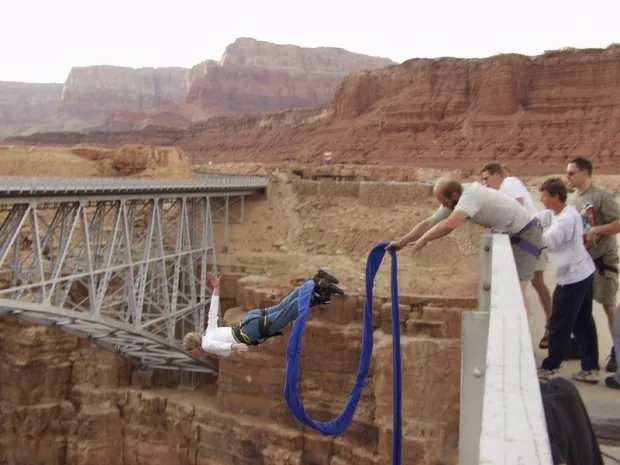
What darkness does to fear is mostly cognitive. In daylight, your brain constantly measures distance - trees, water, buildings, other people. At night those references dim. The freefall can feel longer because you cannot “see the end.” Some jumpers report less pre-jump panic because they cannot fixate on the drop; others report more panic because imagination fills the gap. Neither reaction is wrong. Night bungee is a personality test as much as a height test.
Sensory tradeoffs cut both ways. City tower jumps at night can be spectacular: light grids, harbor reflections, traffic streaks. Natural gorge jumps trade spectacle for void - sound of river or wind, limited platform lights, a bounce into blackness. Mist and spray at waterfall sites can catch beams and look ethereal, but moisture also affects comfort and sometimes operations. Extreme-sport coverage often notes that environment multiplies risk perception even when procedures stay constant.[3]
Safety does not take a night off. Weight checks, cord selection, ankle or full-body harness systems, backup connections, and jump-master commands remain non-negotiable. Lighting should make buckles and carabiners inspectable. Communication should be clear enough that a nervous jumper still hears the countdown. If an operator treats night as a marketing gimmick with dim headlamps and vague briefings, walk away. Darkness is not a discount on standards.
Practical tips if you book: arrive even earlier than for a day jump; eat lightly; wear layers you can jump in; ask about photography lighting so you are not surprised by strobes; and tell staff if you have balance issues, severe anxiety, or night-vision problems. Some medical exclusions matter more when visual orientation is reduced. Listen for weather calls - night winds can differ from afternoon patterns, and responsible sites cancel freely.
Is the dark worth the extra fear? For jumpers chasing novelty after a daytime first jump, often yes: it feels like a different sport wearing the same harness. For first-timers who already struggle with heights, night can either help (less visual overwhelm) or hurt (more unknown). Be honest about which kind of fear motivates you. Bragging rights are real; so is the possibility that you would enjoy the same freefall more with a sunset view.
If you go, treat night bungee as a premium experience: choose operators with transparent policies, read recent reviews mentioning night sessions specifically, and plan transport home after the adrenaline crash. The bounce still ends with you hanging in a harness under a dark sky, laughing or shaking or both. That quiet moment - city lights or river dark below - is what people remember when they say the dark was worth it.
Photography and memory work differently after dark. Camera sensors struggle; phone shots blow out platform lights and crush shadow detail. Many people remember night jumps as feeling-first experiences rather than postcard experiences. If documentation matters to you, ask whether the operator runs pro lighting packages or whether a daytime jump better serves your album. Some travelers deliberately do day first for photos and night second for pure sensation - an expensive double dip that makes sense if freefall is your trip’s centerpiece.
Group dynamics shift at night too. Friends cannot easily read your face on the edge; nervous laughter sounds louder; the walk to the platform may pass through dim corridors or floodlit steel that feels cinematic. Solo travelers sometimes prefer night sessions precisely because the social performance of daytime tourism drops away. Couples and friend groups should agree in advance that any one person can veto without ridicule - peer pressure is more dangerous when everyone is tired and hyped.
Physically, evening jumps may follow a full day of travel or sightseeing. Fatigue raises stumble risk on stairs and reduces decision quality. Eat a normal meal hours before, not a heavy feast minutes before; hydrate; and treat alcohol as a hard no even if nightlife is nearby. Operators already ban impairment; your private pre-game should match their rule. Sleep after, not a club marathon, if you want the memory sharp.
Destinations that combine night bungee with city lights - harbor towers, urban cranes at festivals, bridge towns with evening markets - can make the whole night a story, not only the five seconds of freefall. Budget time to sit after retrieval and watch the landscape without rushing to the next attraction. The dark is worth it when you choose it for the right fear, at the right operator, on a night the weather agrees.
Sources
- Wikipedia - Bungee jumping (2024)
- AJ Hackett (2024)
- The Guardian - extreme sports (2024)
Image credits
- Photo: Diego Delso / Wikimedia Commons (CC BY-SA 4.0)
- Photo: Don Graham from Redlands, CA, USA - God bless it! / Wikimedia Commons (CC BY-SA 2.0)