A bungee jump feels weird because your body is swapping energy types on a short, violent schedule. Height becomes speed. Speed becomes stretch. Stretch throws you back up. Then the cord wastes energy until you hang still.
You do not need equations on the platform. You do need the sequence so the "stomach drop" and the "hard pull" stop feeling like random chaos.
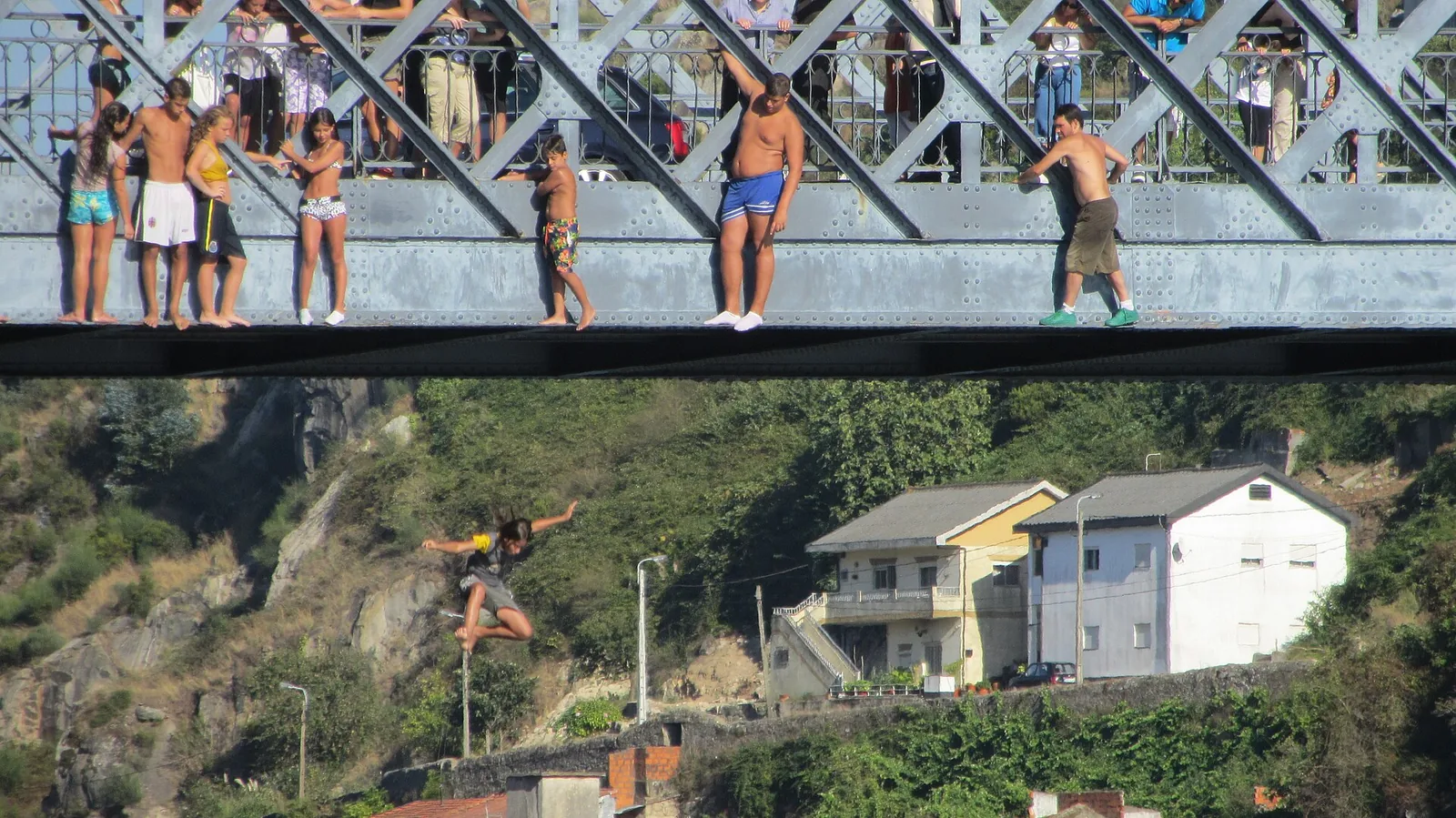
What happens in freefall
On the edge you still feel your weight. The deck is pushing up on you. Step off and that support vanishes. For a few seconds you are in freefall—gravity accelerates you downward and you feel roughly weightless, the same basic idea as a drop tower, only the view is real rock or river.[1]
That is the open-air scream stretch. Nothing magical. You are trading gravitational potential energy for kinetic energy as you pick up speed.[2]
When the cord takes over
When the slack is gone, the cord stretches. Kinetic energy starts becoming elastic energy stored in the rubber. In classroom physics, Hooke's law is the simple model: more stretch means a larger restoring force, as long as you stay inside the elastic range of the material.[3]
Real commercial cords are engineered systems, not lab springs. The intuition still helps. Stretch farther and the upward pull grows. Eventually that pull exceeds your weight. Acceleration reverses. The fall bottoms out into a deep load, then a fling skyward. That reversal is what people remember as a hard pull, not a soft cradle—because rapid changes in acceleration are loud to your body.
Operators match cord setup to weight so the low point stays clear of ground, water, or obstacles with margin.[4] That is why the scale at check-in is not optional theater. Heavier jumper, more energy to manage. Lighter jumper, different cord behavior. Lying about weight is a clearance and load problem, not a white lie.
Why the bounce keeps going
On the way up, elastic energy converts back toward kinetic and gravitational potential. You rise, slow, fall again. Each cycle dumps some energy as heat and internal losses in the cord, so bounces get smaller until you hang near equilibrium waiting for retrieval.
If a cord were permanently deformed past its useful elastic range, behavior would get unpredictable. That is one reason serious sites inspect gear and retire cords on schedules rather than "until it looks tired."[4]
What physics does not cover
Equations do not include a waterfall roar, a camera phone, or a friend screaming your name. Those crank the subjective intensity of the same accelerations. Two people on similar setups can rate the same ride totally differently. Physics explains the mechanical ride. Expectation and attention explain your review.
Related: g-forces on the body, why the bounce feels strange.
Bottom line: freefall is the light part, cord stretch is the heavy part, rebound is energy coming back, and damping is why you eventually hang still. Trust the sequence—and the operator whose math matches your mass and the site’s clearance.
Sources
- Encyclopaedia Britannica — free fall (weightlessness under gravity alone)
- OpenStax College Physics — gravitational potential energy and mechanical energy
- OpenStax College Physics — Hooke's law (elastic restoring force)
- AJ Hackett Bungy NZ — Is bungy jumping safe? (weight matching, inspections, weather)
Image credits
- Photo: Dariusz Jemielniak ("pundit") / Wikimedia Commons (CC BY-SA 4.0)
- Photo: Brian Johnson & Dane Kantner / Wikimedia Commons (CC BY-SA 2.0)