Long before ticket booths and GoPro mounts, people on Pentecost Island in Vanuatu practiced naghol - land diving - from wooden towers with vines tied to their ankles. The ritual is agricultural and spiritual as much as athletic: a display of courage tied to yam harvest cycles and community identity, not a tourist product in its original form.[1][4] Those vine leaps are the cultural ancestor modern bungee loves to claim, even though materials, motives, and risk controls differ profoundly.
Land diving uses carefully chosen vines and tower construction knowledge passed through practice. Divers aim to brush the earth, blessing the ground. Injuries can and do happen; this is not a sanitized theme-park story. Respect matters when retelling it. The point for bungee history is continuity of idea - human freefall arrested by elastic or semi-elastic lines - not a straight line of ownership from Vanuatu to a city tower.
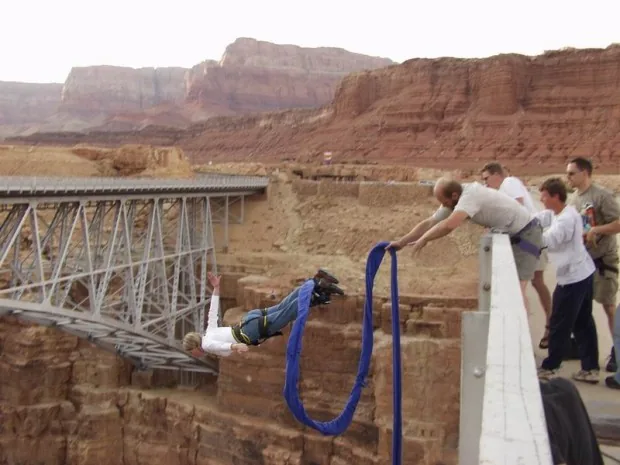
Twentieth-century experiments translated the idea into Western stunt and sport culture. In the late 1970s and early 1980s, members of the Oxford University Dangerous Sports Club staged jumps from bridges using elastic ropes, capturing media attention and establishing a daredevil template.[2] Those jumps were closer to performance art than regulated tourism. They proved public appetite and sketched the method.
Commercialization arrived when innovators - most famously New Zealander A.J. Hackett and collaborators - combined elastic cord systems, public spectacle, and repeatable operations. Hackett’s jumps from structures such as the Eiffel Tower (as a stunt) and the building of permanent sites like Kawarau Bridge turned freefall into a business with briefings, staff roles, and paying customers.[3][2] New Zealand became a pilgrimage point; the model spread to Australia, Europe, Asia, Africa, and the Americas.
As the industry grew, so did engineering culture: weight-based cord selection, redundant harness systems, platform standards, and emergency training. The sport’s public image swung between pure adrenaline marketing and sobering accident investigations that forced better practice. Modern commercial bungee exists in that tension - selling fear while institutionalizing safety.
Media and tourism cemented the timeline. Documentaries featured land divers; adventure operators sold “world’s highest” claims; celebrities and TV hosts lined up on platforms. Each era added a layer: ritual meaning, student stunt energy, commercial polish, global competition for iconic sites. Today’s jumper inherits all of it when they sign a waiver at a garden-route bridge or a city tower.
What should travelers take from the history? First, humility toward Vanuatu’s living tradition - visit and learn through respectful cultural channels if you go, rather than treating naghol as a costume version of bungee. Second, gratitude for the boring parts of modern ops: inspections, training, and regulation evolved because early eras were riskier. Third, perspective - your two-minute freefall sits on decades of iteration and centuries of human fascination with controlled falling.
From vine and tower to latex and steel, the through-line is courage made communal. Land divers jump for harvest and honor. Club jumpers jumped for rebellion and art. Commercial jumpers jump for bucket lists and charity fundraisers and raw joy. The cord changed. The gasp at the edge stayed familiar.
Anthropology and tourism complicate the Vanuatu chapter. Land diving remains a living custom, not a museum demo, and visitors who treat it as a bungee-themed photo hunt miss the point. If you travel to Pentecost, go with cultural operators who prioritize community protocols over thrill packaging. Pay fairly, ask before photographing, and leave the vines and towers in local hands. Modern bungee can honor an inspiration without extracting it.
The 1980s and 1990s spread commercial sites with startling speed once the New Zealand proof points landed. Tour companies folded freefall into backpacker circuits; insurance products matured; local regulators slowly caught up. Each new country adapted the model to its bridges, gorges, and legal systems. Some places embraced permanent tourism infrastructure; others restricted jumping after accidents or public controversy. The map of legal commercial bungee is therefore uneven - another reason to book established operators rather than opportunistic pop-ups.
Technology evolved alongside culture. Better harness design, clearer weight banding, radio procedures, and training syllabi turned “stunt company” energy into something closer to guided adventure sport. Cameras shrank from shoulder mounts to phones, changing how fame works: every customer can now broadcast a personal landmark moment from a regional bridge. That democratization is part of the modern chapter of the history.
Women, adaptive athletes, and older first-timers gradually became more visible in marketing that once skewed purely toward young male daredevil imagery. The physics never required that narrow demographic; culture did. Today’s better operators sell preparation and professionalism to anyone within medical and weight limits. That inclusivity is a quiet historical win worth naming beside the record heights and stunt dates.
Carry the timeline onto the platform as perspective. You are not inventing freefall. You are participating in a chain that includes ritual courage, student absurdity, entrepreneurial spectacle, and contemporary safety bureaucracy. Somewhere between vine and latex, people kept choosing the edge. Your jump adds a small footnote - personal, not monumental - and that is enough.
Sources
- Wikipedia - Land diving (2024)
- Wikipedia - Bungee jumping (2024)
- AJ Hackett - story (2024)
- Britannica - Vanuatu (2024)
Image credits
- Photo: Lyngenfjord Bungee / Wikimedia Commons (CC BY-SA 4.0)
- Photo: Don Graham from Redlands, CA, USA - God bless it! / Wikimedia Commons (CC BY-SA 2.0)