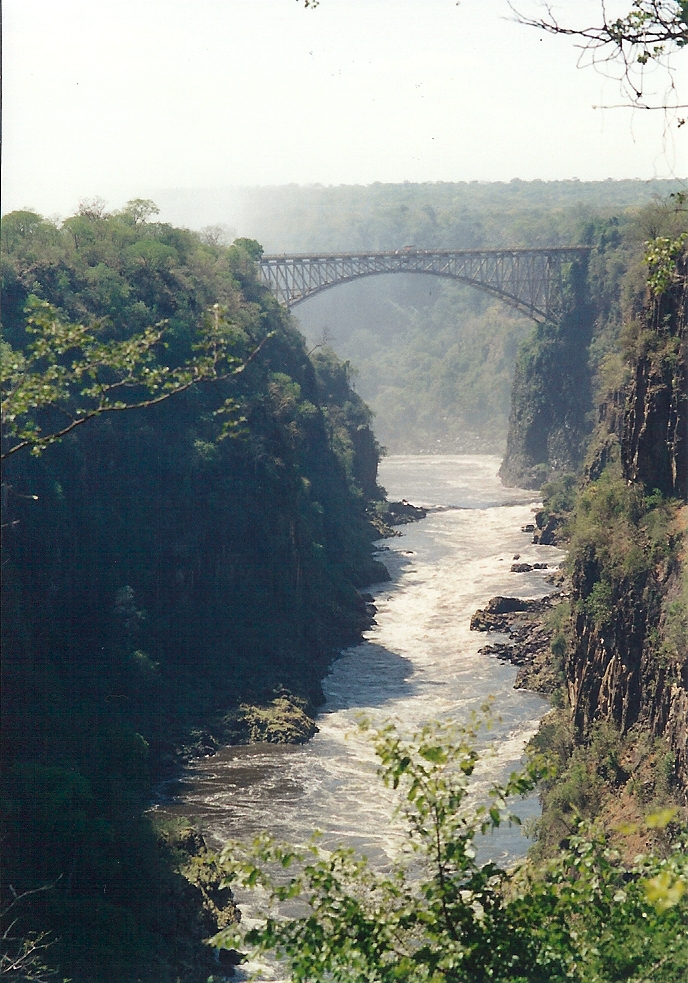
Some bungy sites are destinations you detour to. Victoria Falls is a destination you already planned - and the bridge jump sits inside that pilgrimage like a dare you can actually book. The Victoria Falls Bridge spans the Zambezi gorge downstream of one of the world’s great waterfalls, linking a binational tourism region that thrives on spray, viewpoint trails, and adventure add-ons.[3][4] When someone in your group jumps here, the rest of you are not waiting in a warehouse. You are standing inside a postcard that just gained a plot.
That is the shared-landmark effect. Freefall becomes a chapter in a story the whole trip already owns.
Why the setting changes the social experience
Commercial operations on the bridge - widely associated with Shearwater’s bungee, bridge swing, and related products - publish the practical frame: height in the neighborhood of one hundred eleven metres, schedules, weight bands, and age rules that serious guests should read before they romanticize the mist.[1][2] What marketing cannot fully convey is the audio-visual stack: gorge wind, distant roar of the falls in high water, trains and foot traffic history in the steel under your shoes, and the knowledge that two countries’ tourism towns orbit this crossing.
Spectators and jumpers share the same landmark grammar. Everyone has already said “the bridge” and “the falls” at breakfast. The jump does not invent a private world; it borrows a public one. That makes post-jump conversation easier - you are describing a place the others can still see, smell, and point at.
Design the day for the group, not only the jumper
If one person jumps and four people wait, give the wait a role. Book a viewpoint morning at the falls so the gorge geometry is in everyone’s body before the platform. Align border and bridge logistics early - this region rewards travelers who respect immigration and timing rather than improvising at the last hour.[2][4] Decide who holds bags, who films if allowed, and who is the emotional anchor if nerves spike.
After the jump, do not rush to the next adrenaline product unless the jumper asks for it. A long lunch, a sunset deck, or a quiet walk where spray can still be heard often serves the group better than stacking swings and rafts on the same nervous system. Shared landmark experiences peak when there is time to integrate.
Ritual without pressure
Landmark energy can tip into peer pressure. Protect the jumper’s right to reschedule or convert to a swing if that is the wiser product that day. Protect non-jumpers from shame, too - watching from the bridge or a designated area is a full participation mode, not a lesser ticket.[1] The falls will still be thunderous if nobody leaves the deck.
Couples and friend groups often use this jump as a trip punctuation mark: after wildlife, before departure, or mid-itinerary as a courage checkpoint. Whatever the narrative, keep medical honesty and operator instructions above the story you wanted to tell on social media.[2]
What you take home together
Years later, groups rarely remember the exact freefall duration. They remember the walk onto the structure, the collective inhale, the yell that might have been laughter, and the way the waterfall region felt slightly more theirs afterward. That is the gift of a shared landmark jump: the sport product and the world heritage backdrop fuse into one travel memory with multiple witnesses.[3][4]
Plan Victoria Falls for the falls first. Let the bridge jump be the optional lightning strike inside a place you already came to honor. When it works, freefall is not an isolated stunt - it is a few elastic seconds when a famous view becomes a story you all own.
Shared landmark jumps also change how you budget attention across a multi-day Falls visit. Many groups try to do wildlife, viewpoints, and freefall as if they were equal checklist items. A kinder model is hierarchical: the falls themselves remain the pilgrimage, the bridge jump is an elective ritual, and everything else is connective tissue. That hierarchy reduces the odd guilt spectators feel when they are "only watching," because watching becomes part of witnessing a place, not failing a sport.[4]
If children or reluctant adults are in the party, brief them on what they will see and hear - the countdown, the yell, the rebound - so surprise does not become distress. Give them a job that is real but light: holding a jacket, spotting the recovery, choosing the celebration snack. Inclusion without pressure is the social technology that turns a commercial bungy into a family story instead of a private ordeal with hostages on the railing.[1][2]
Finally, leave time to return to a quiet viewpoint after the jump day. Seeing the gorge again without a harness nearby reintegrates the landscape as landscape. The landmark stops being only a launch stage and becomes, again, one of the world's great water-and-stone theatres - now with your group's private annotation written in adrenaline and laughter.[3]
Sources
- Shearwater Bungee - Victoria Falls Bridge (2026)
- Victoria Falls Guide - Bungee Jumping (2025)
- Wikipedia - Victoria Falls Bridge (2025)
- Wikipedia - Victoria Falls (2025)
Image credits
- Photo: JackyR / Wikimedia Commons (CC BY-SA 3.0)
- Photo: JackyR / Wikimedia Commons (CC BY-SA 3.0)