Every April, May and June, men and boys in the south of Pentecost Island, Vanuatu, climb a tower of logs and branches, tie forest vines to their ankles and dive head first towards the ground. The ceremony is called Naghol (also written Nagol or N’gol), and it is the reason a group of Oxford students tied elastic ropes to their ankles and stepped off a Bristol bridge in 1979. This guide covers both stories: what land diving is and how visitors can watch it respectfully, and how a ritual filmed by the BBC turned, within a decade, into a ticketed sport in New Zealand.
Bungee history at a glance
| Date | Event | Source |
|---|---|---|
| Centuries old | Naghol practised in southern Pentecost to mark the yam harvest | [1][2] |
| 21 Apr 1960 | BBC broadcasts David Attenborough’s film The Land Divers of Pentecost | [3] |
| 1974 | A diver dies at a jump staged during Queen Elizabeth II’s visit, out of season, when the vines snapped | [1][4] |
| 1 Apr 1979 | David Kirke and the Oxford University Dangerous Sports Club jump the Clifton Suspension Bridge, Bristol, about 76 m up | [5][6] |
| Jan 1980 | Chris Sigglekow makes a test jump from the Pelorus Bridge, New Zealand | [7][8] |
| By 1982 | The club has jumped the Golden Gate and Royal Gorge bridges in the US and is jumping from cranes and hot-air balloons | [6] |
| 1986 | Michael Lush dies rehearsing a bungee-style TV stunt for the BBC | [9] |
| Nov 1986 | A.J. Hackett’s first jump, from the 19 m Greenhithe Bridge in Auckland | [7] |
| 26 Jun 1987 | Hackett jumps about 110 m from the Eiffel Tower at dawn | [8][7] |
| Mar 1988 | AJ Hackett opens a commercial bungy site at Ohakune | [10][7] |
| 12 Nov 1988 | Kawarau Bridge, Queenstown, opens to the paying public: 28 people pay NZ$75 each for a 43 m jump | [10][11] |
| 1989 | First draft of a Bungy Code of Practice, later the standard AS/NZS 5848 | [7] |
| 2006 | Macau Tower bungy opens at 233 m | [7] |
| Dec 2019 | Vanuatu passes a traditional-knowledge law that names the Nagol jump | [1] |
What land diving on Pentecost Island is
Naghol is performed in the south of Pentecost. The Vanuatu Tourism Office describes towers up to 30 m (about 98 ft) high, built from logs and tied together with vines, and divers who jump barefoot with vines around their ankles. The vines are chosen for strength and flexibility and their length is worked out for each diver, because the aim is to come as close to the ground as possible [2]. The Otago Daily Times put the margin bluntly: a vine just 10 cm too long can mean serious or fatal injury [4].
Only men jump. In some communities the dive is treated as a rite of passage, and divers start young: the ODT reported boys as young as seven taking part [4][2]. ABC News described a tower raised by Chief Luke Fargo, 69, at the southern tip of the island after the monsoon season, with men in traditional nambas and women in grass skirts [1]; the watching villagers dance, stamp and shout as each diver falls [4].
The ceremony is tied to the yam, a staple crop. Divers jump to bless the harvest, and by one tradition a good dive in which the diver’s hair or shoulders brush the softened earth bodes well for next year’s crop [4][2]. Timing matters for practical reasons too: as the dry season sets in, the vines become less pliable and more likely to snap [4].
The origin legend
Several versions circulate, and sources hedge them. The most common tells of a woman who fled an abusive husband, named Tamale in one telling, and climbed a tall tree. When he climbed after her she jumped, having tied vines to her ankles; he jumped too, without vines, and died [4][1]. AJ Hackett Bungy’s own history page retells the legend and adds that the jump was at first re-enacted by women before men took it over [11]. Treat all of these as stories told about the ritual, which is what they are.
Land diving vs bungee jumping
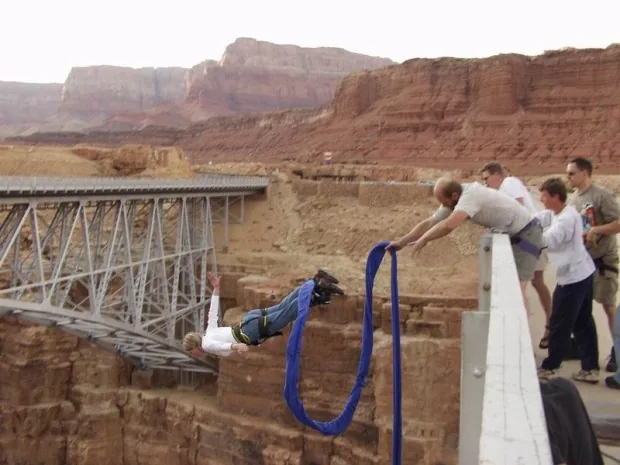
The resemblance is obvious, and the differences matter. The Vanuatu Tourism Office once said Naghol bears no more resemblance to bungy jumping than abseiling down a 20 m cliff does to riding a lift down a six-storey building [4]. The table sets the two side by side.
| Naghol (land diving) | Commercial bungee | |
|---|---|---|
| Line | Forest vines, cut and measured for each diver | Engineered elastic cord matched to the jumper’s weight |
| Platform | Hand-built tower, up to about 30 m | Bridges, towers, cranes and gondolas, up to 233 m (Macau) |
| Goal | Come as close to the ground as possible | Stop well clear of the ground or water, then rebound |
| Who jumps | Men and boys of the community | Paying customers within an operator’s weight and age limits |
| When | April to June, around the yam harvest | Year-round at many sites |
| Rules | Custom, chiefs and community | Operator procedures and, in New Zealand, AS/NZS 5848 |
Sources: [2][4][7]. For today’s limits by operator, see bungee weight and age limits; for the tallest platforms, see the highest bungee jumps in the world.
When land diving goes wrong
Divers do get hurt. The best-known death came in 1974, when a jump was staged for Queen Elizabeth II during her visit to what was then the New Hebrides. It was held outside the usual season, the vines had lost their elasticity, and they snapped; the diver suffered a broken neck and died [1][4]. Pacific Islands Monthly reported the death in April 1974 under the headline “Strange story of a death dive and a tabu”, asking whether a broken taboo or an accident was to blame [12]. In 2006, after three divers were injured in falls and one was left paralysed, the Vanuatu Cultural Centre warned organisers against over-using the ceremony for tourists [4].
The lesson carries straight into modern bungee: the line has to suit the conditions and the person. Our guide to bungee jumping accidents and safety covers how commercial jumps fail and how often.
How to see land diving in Vanuatu
The Vanuatu Tourism Office lists the 2026 season as every Saturday from 4 April to 27 June, at Ratap on Pentecost. Its published fee is 9,500 vatu for adults and 4,000 vatu for children, roughly US$80 and US$34 at October 2026 rates [2][13]. Check the current listing before booking flights.
- Book through an organised visit. The tourism office advises that ceremonies in the villages are community events; visitors may need an invitation, a local guide or a custom fee [2].
- You watch; you do not dive. The jumps are performed by local men. If you want to jump yourself, that is what commercial bungee is for.
- Follow the community’s rules on site. Ask your guide about photography and where visitors may stand.
Who owns the jump?
Some Pentecost chiefs say bungee companies have profited from their ceremony and want compensation from operators [1]. In December 2019 Vanuatu passed a traditional-knowledge bill that names the Nagol jump of south Pentecost and its resemblance to bungee. John Huri of the Vanuatu Intellectual Property Office told ABC News the law requires prior informed consent from the knowledge holders before such knowledge is used, and the government was working with UNESCO and the World Intellectual Property Organization on protections [1].
AJ Hackett Bungy does credit land diving as the origin of bungy on its own history page [11].
1979: the Dangerous Sports Club at Clifton
Guinness World Records lists the first modern bungee jump as 1 April 1979, from the Clifton Suspension Bridge in Bristol, about 76 m (250 ft) above the River Avon. David Kirke went first, dressed in a top hat and tails and holding a bottle of champagne, followed by Simon Keeling, Alan Weston and Tim Hunt, all members of the Oxford University Dangerous Sports Club [5]. The idea came from land diving; Guinness and the BBC both credit the Pentecost ritual as the inspiration [5][14].
The jumpers were arrested. Accounts of the penalty differ: the Guardian’s obituary of Kirke says they were fined £100 each for disturbing the peace, while the BBC’s 2014 report on newly found film of the day says they were later given a warning [6][14]. Bungee from the bridge is now banned under bylaws [6]. The club carried on, jumping the Golden Gate Bridge in San Francisco and the Royal Gorge Suspension Bridge in Colorado, and by 1982 it was jumping from mobile cranes and hot-air balloons [6][5]. Kirke re-enacted the Clifton jump for its 21st anniversary in 2000 and died in October 2023, aged 78 [5][6].
Television, risk and a death in 1986
Elastic jumps were fresh territory for television in the 1980s. In 1986 Michael Lush, taking part in the BBC’s The Late, Late Breakfast Show, died rehearsing a bungee-style stunt when a carabiner came loose during a jump from a crane [9]. The show was taken off air. The full account is in the Michael Lush accident.
New Zealand: from stunt to business
New Zealand’s story starts in January 1980, when Chris Sigglekow, who had heard about the Oxford jump, made a test jump from the Pelorus Bridge with a borrowed parachute harness and a cord cut to a guessed length. AJ Hackett’s own timeline says he went feet first into the river at close to full speed before the cord took his weight [7][8].
A.J. Hackett made his first jump in November 1986 from the 19 m Greenhithe Bridge over Auckland’s Waitematā Harbour [7]. With Henry van Asch he developed bungy cords with help from scientists at the University of Auckland [11]. Then came the publicity stunt: on 26 June 1987 his team hid on the Eiffel Tower overnight and Hackett jumped about 110 m at dawn. He was arrested and released shortly afterwards, and the footage went around the world [8][11].
The company dates its first commercial site to Ohakune in March 1988. On 12 November 1988 it opened at the 43 m Kawarau Bridge near Queenstown, which AJ Hackett International calls the first year-round commercial public bungy site; 28 people paid NZ$75 each on opening day [10][7]. AJ Hackett Bungy NZ and NZHistory describe Kawarau simply as the first commercial bungy operation, so you will see both claims [11][8]. Kawarau still runs today; see the best bungee jumping locations in the world for current prices and the other Queenstown sites.
Safety codes and how the sport spread
In 1989 a first draft of a Bungy Code of Practice was presented; it became AS/NZS 5848, the standard that still governs bungy in New Zealand [7]. The company opened sites in France and Cairns in 1990, in the United States in 1994 and in Bali in 1995, opened the Nevis near Queenstown in 1999 and opened its 233 m jump from Macau Tower in 2006. By July 1999 it had sold its millionth jump [7].
Many other operators followed. For prices at today’s best-known sites, see how much bungee jumping costs.
FAQ
Did bungee jumping come from land diving?
Partly. The Oxford University Dangerous Sports Club, who made the first modern bungee jump in 1979, were inspired by Pentecost Island land diving [5][14]. The equipment is different: divers on Pentecost use forest vines, while bungee uses elastic cord.
When and where was the first bungee jump?
Guinness World Records lists 1 April 1979, from the Clifton Suspension Bridge in Bristol, England, about 76 m above the River Avon, by David Kirke and three other club members [5].
Who invented bungee jumping?
No single person. Land diving on Pentecost is centuries old, the Dangerous Sports Club made the first elastic-rope jumps in 1979, and A.J. Hackett and Henry van Asch developed commercial cords and opened the first public sites in New Zealand in 1988 [1][5][10].
Where is the original bungee jump in New Zealand?
The Kawarau Bridge near Queenstown, 43 m, opened to paying jumpers on 12 November 1988. AJ Hackett also dates an earlier commercial site at Ohakune to March 1988 [10][7].
How high are land diving towers?
Up to about 30 m (98 ft), according to the Vanuatu Tourism Office [2].
When can you see land diving on Pentecost Island?
On Saturdays during the season, which in 2026 runs from 4 April to 27 June. The tourism office fee is 9,500 vatu for adults and 4,000 vatu for children (about US$80 and US$34) [2][13].
Can tourists do land diving?
No. The dives are performed by men from the local communities as part of a ceremony. Visitors watch, usually as part of an organised trip [2].
Has anyone died land diving?
Yes. A diver died in 1974 at a jump staged out of season for Queen Elizabeth II, when the vines snapped [1][4].
Sources
- ABC News (Prianka Srinivasan), 12 Jan 2020: Vanuatu’s Nagol jump and the push to protect it
- Vanuatu Tourism Office: Naghol (land diving) event page, 2026 season, fees and visitor guidance
- BBC Programmes: The People of Paradise, “The Land Divers of Pentecost” (first shown 21 April 1960)
- Otago Daily Times, 18 May 2009: Death-defying dives
- Guinness World Records: First bungee jump
- The Guardian, 25 Oct 2023: David Kirke, who performed the first modern bungee jump, dies aged 78
- AJ Hackett International: company timeline
- NZHistory (Ministry for Culture and Heritage): A.J. Hackett bungy jumps from Eiffel Tower
- Wikipedia: The Late, Late Breakfast Show (death of Michael Lush, 1986)
- Skypark by AJ Hackett: company history
- AJ Hackett Bungy NZ: About us
- Pacific Islands Monthly, Vol. 45 No. 4 (1 April 1974): “Strange story of a death dive and a tabu” (via Digital Pasifik / Trove)
- ExchangeRate-API open rates, USD base, Oct 26, 2026 (approximate US dollar conversions)
- BBC News, 10 Nov 2014: footage of the first bungee jump from Clifton Suspension Bridge
Image credits
- Photo: Lyngenfjord Bungee / Wikimedia Commons (CC BY-SA 4.0)
- Photo: Don Graham from Redlands, CA, USA / Wikimedia Commons (CC BY-SA 2.0)